vidIQ Research, July 2026
YouTube First 10 Videos Study: Shorts vs Long-Form
This study looks at YouTube channels created between January and June 2025 that posted at least ten public videos of the same format, Shorts or long-form, within their first 90 days. Every channel in this cohort has a real first, fifth, and tenth upload to point to, so we tracked how each of those did, plus the best-performing upload among the first ten, 30 days after publishing. Two cohorts were built separately: 367,243 channels qualified on Shorts, 137,355 qualified on long-form (excluding live streams). 56,185 channels qualified for both, and 448,413 distinct channels qualified for at least one.
vidIQ Research/Updated July 30, 2026
The finding
More Uploads = More Luck
For long-form, we see incremental growth as more content is posted: views go from 180 on the first upload to 211 on the fifth to 272 on the tenth, up 51% overall. But the bigger opportunity is that more uploads mean more chances at an outlier of over 1,000 views. The typical best long-form video hit 1,948 views, 10.8 times the first upload. Shorts work differently. There's no incremental growth, in fact a slight decline over time: 1,362 views on the first upload, 1,275 on the fifth, 1,344 on the tenth. But the same logic applies: more uploads mean more chances at an outlier of thousands of views. The typical best Short hit 8,832 views, 6.5 times the first upload. The takeaway is that volume buys you more tries at the one that breaks out.
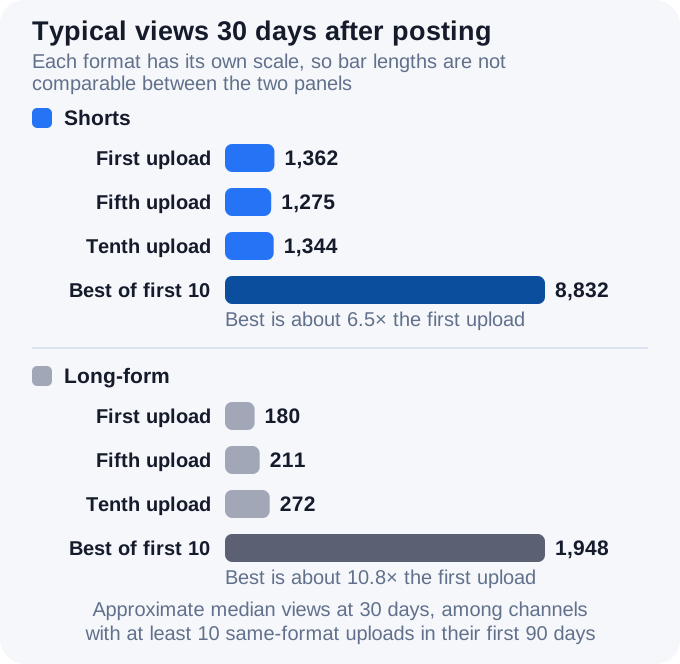
| Upload position | Shorts | Long-form |
|---|---|---|
| First upload | 1,362 | 180 |
| Fifth upload | 1,275 | 211 |
| Tenth upload | 1,344 | 272 |
| Best among first 10 | 8,832 | 1,948 |
Shorts channels reached 1,000 views far more often
Among channels that posted at least ten Shorts in their first 90 days, 86.5% had at least one of their first ten Shorts reach 1,000 views within 30 days. Among channels posting at least ten long-form videos, excluding live streams, 57.8% did. At the 10,000-view mark it was 48.0% for Shorts against 30.8% for long-form. Those figures describe a channel's single best video out of ten attempts, not a typical video. Looked at per video instead of per channel, only 56.6% of individual Shorts in this cohort reached 1,000 views, and just 20.9% reached 10,000. For long-form, 30.2% of individual videos reached 1,000 views and 10.0% reached 10,000. The gap between the best-of-10 rate and the per-video rate is the story: most of a channel's early uploads fall well short of its best one.
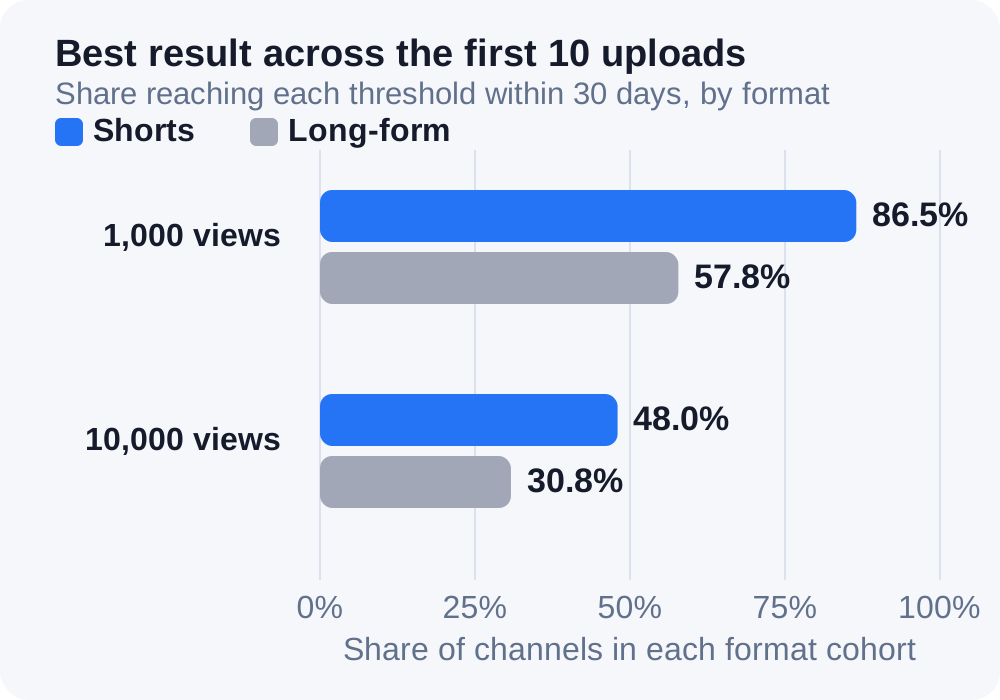
| 30-day view threshold | Shorts | Long-form |
|---|---|---|
| At least 1,000 views | 86.5% | 57.8% |
| At least 10,000 views | 48.0% | 30.8% |
Related resources
What this does not prove
- This is an observational study of a selected group of channels, not an experiment.
- It does not show that choosing a format, or posting more videos, causes better results.
- Channels chose their own format and their own schedule, so any difference between the two groups also reflects whatever else differs between the people who made those choices.
- Channels that gave up before publishing ten same-format videos in their first 90 days are excluded entirely, which removes exactly the channels that stopped.
- The long-form cohort excludes live streams.
- Deleted, private, and unindexed videos are absent, so some early uploads are invisible to this analysis.
- Channels can appear in both cohorts, so the two cohort sizes overlap and must not be added together.
- Views are not subscribers, and none of this guarantees a result for any individual channel.
Methodology
- Creation window: channels were created from January 1 through June 30, 2025.
- Format cohorts: Shorts and long-form were analyzed separately, and the long-form cohort excludes live streams. A channel needed at least ten observed public uploads of that format within its first 90 days to enter the format's cohort.
- Cohort sizes: 367,243 channels qualified for Shorts and 137,355 qualified for long-form, excluding live streams. The cohorts overlap: 56,185 channels qualified for both, and 448,413 distinct channels qualified for at least one. Cohort sizes must not be added together.
- Upload ranking: each format's uploads were ordered separately by publish time. First, fifth, and tenth refer to those same-format positions. Best is the maximum 30-day view result among the first 10 same-format uploads.
- View measure: results use observed views 30 days after publication. Views are not subscriber counts.
- Selection limits: this is an observational, selected sample, not a random sample or a census. Channels with fewer than ten same-format uploads are excluded, which removes channels that stopped posting early. Deleted, private, and unindexed videos are absent.
- Interpretation: medians are approximate percentile estimates that reduce the influence of unusually large results. Threshold rates describe each channel's best observed same-format upload among ten, not a typical upload; per-video rates are reported separately to show the gap between the two. Neither establishes cause or guarantees an individual result.