vidIQ Research, July 2026
YouTube Title Study: What 4 Million Videos Reveal
We analyzed more than 4 million videos uploaded in 2026 to identify the title frames associated with unusually high view performance. Specific story promises led the field, while several familiar formulas no longer stood out.
vidIQ Research/Updated July 16, 2026
Watch the original video analysis on YouTube
Study parameters
4M+
Videos analyzed
2026
Upload year
Views vs average
Performance measure
The finding
Specific story frames beat generic title formulas.
Caught-on-camera titles showed more than 4 times the average views in the source analysis. Turning-X-into-Y transformation titles exceeded 3 times average, while access and insider frames exceeded or reached 2.5 times. The common thread was a concrete story promise, not a standalone buzzword.
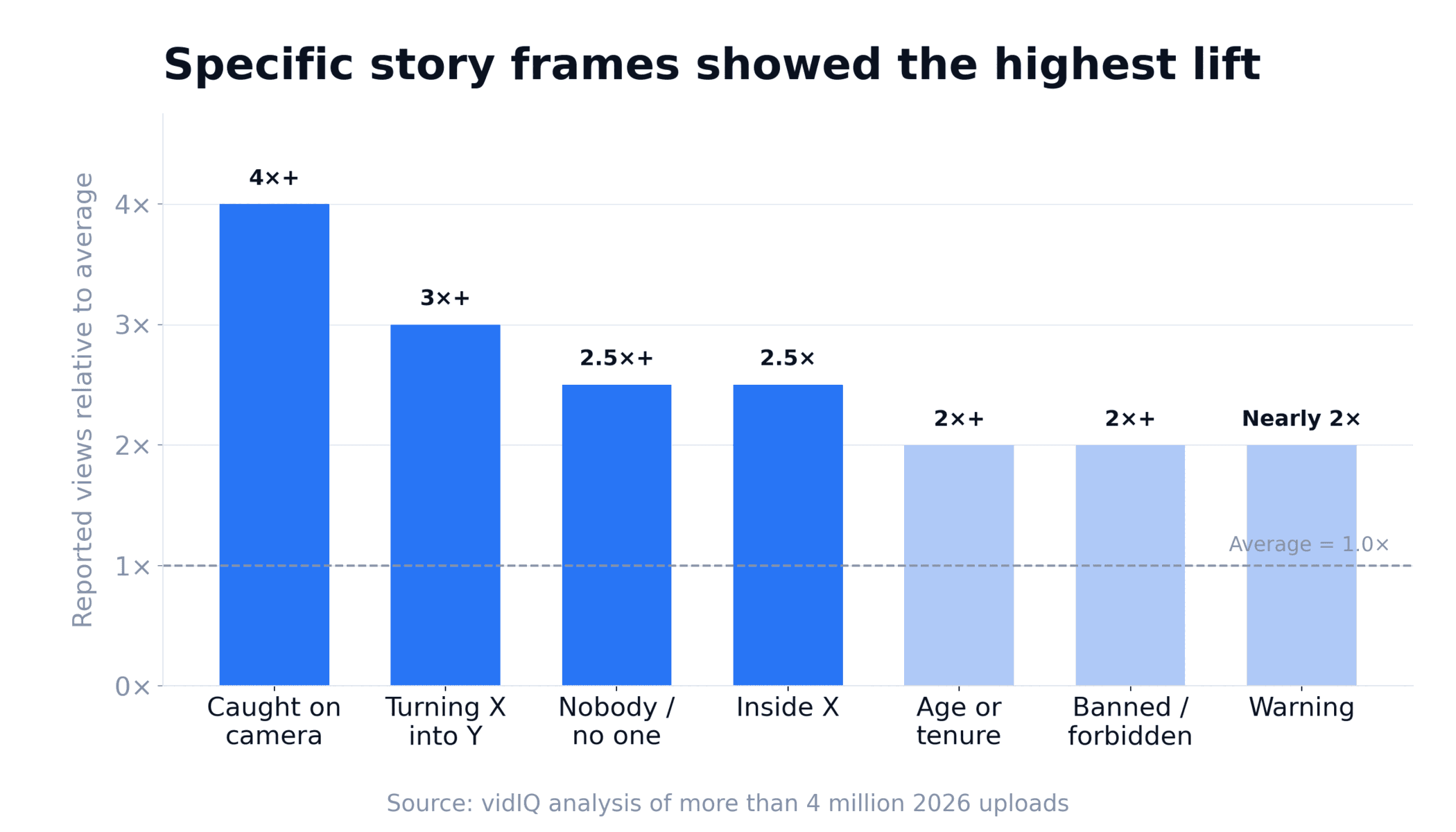
| Title frame | Reported performance | Core promise |
|---|---|---|
| Caught on camera | More than 4× average | Witnessed footage |
| Turning X into Y | More than 3× | Visible transformation |
| Nobody or no one knows | More than 2.5× | Insider knowledge |
| Inside X | 2.5× | Hidden access |
| Age or tenure | More than 2× | Earned credibility |
| Banned, forbidden, or illegal | More than 2× | Restricted access |
| Do not, stop, or never | Nearly 2× | Warning and loss avoidance |
| How X did a surprising thing | Nearly 2× | Narrative payoff |
| Specific superlative | More than 1.5× | Meaningful extreme |
| X days, hours, or years | Nearly 1.5× | Bounded journey |
Several familiar patterns were average or below
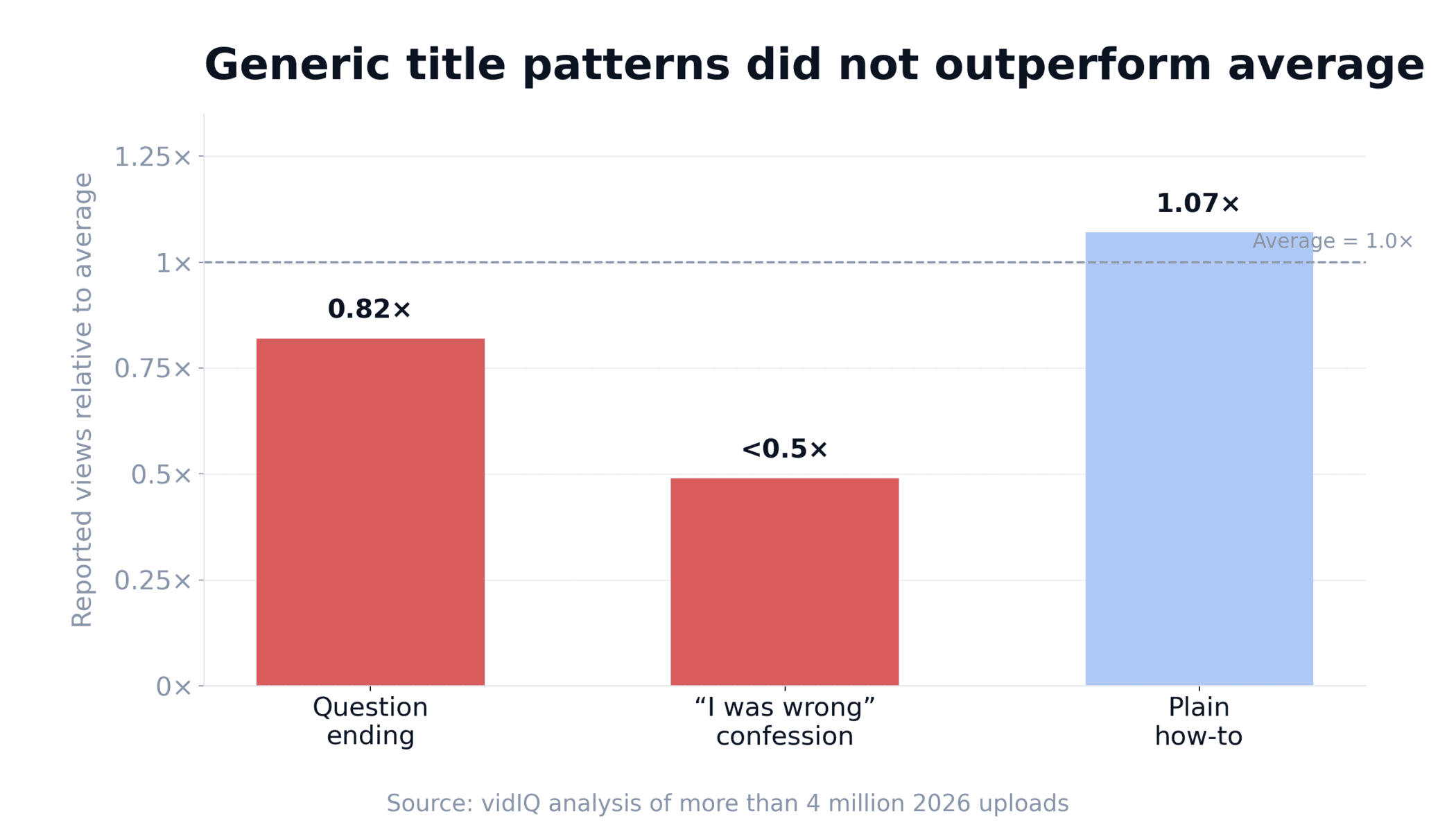
Titles ending in a question came in at 0.82 times average, or about 18% below average. I-was-wrong confession titles were below half of average, while a plain how-to without a twist was effectively average at 1.07 times.
What this does not prove
The study is observational. It does not show that inserting one phrase causes more views. Topic demand, channel size, audience fit, thumbnail quality, timing, and the underlying video can all influence performance. The reported frames should be treated as amplifiers for viable ideas, not fixes for weak ones. Raw-title cell counts and regression controls were not published with the source video, so the lift figures are descriptive rather than causal estimates.
Methodology
- Source corpus: more than 4 million YouTube videos uploaded in 2026, as reported in vidIQ's original analysis published on June 18, 2026.
- Metric: relative view performance compared with the average video in the source analysis. A value of 1.0 times represents average performance.
- Frame grouping: the source analysis grouped recurring title structures by the promise they make, including witnessed footage, transformation, hidden access, warning, credibility, insider knowledge, forbidden access, narrative, superlative, and duration.
- Threshold reporting: several findings were published as boundaries such as more than 4 times or nearly 2 times. This page preserves those boundaries instead of adding false precision.
- Stacking review: the largest cited outliers combined three or four frames in one coherent idea. Stacking was reviewed as a recurring pattern, not as an independent causal variable.
- Limitations: the public analysis did not disclose the number of titles in each frame, niche-adjusted results, the complete data export, or a controlled regression. Results may reflect topic and channel differences as well as title structure.