vidIQ Research, September 2026
Reaching 1,000 YouTube Subscribers: What 32.9 Million Channels Reveal
We analyzed 32,926,088 YouTube channels that had fewer than 1,000 subscribers and at least one video 360 days earlier. The share reaching 1,000 subscribers was higher in every group with a larger net increase in video count.
vidIQ Research/Updated September 11, 2026
Study parameters
32,926,088
Channels analyzed
0–999
Subscribers at baseline
360 days
Observation window
The finding
Over 30% of small channels with 52+ more videos reached 1,000 subscribers.
Small channels here means channels starting below 1,000 subscribers. We compared subscriber and video counts over 360 days. Just 0.20% of channels with unchanged video counts reached the same milestone. The rate rose to 1.86% with an increase in video count of 1 to 11, 8.65% with 12 to 51, and 30.77% with 52 or more.
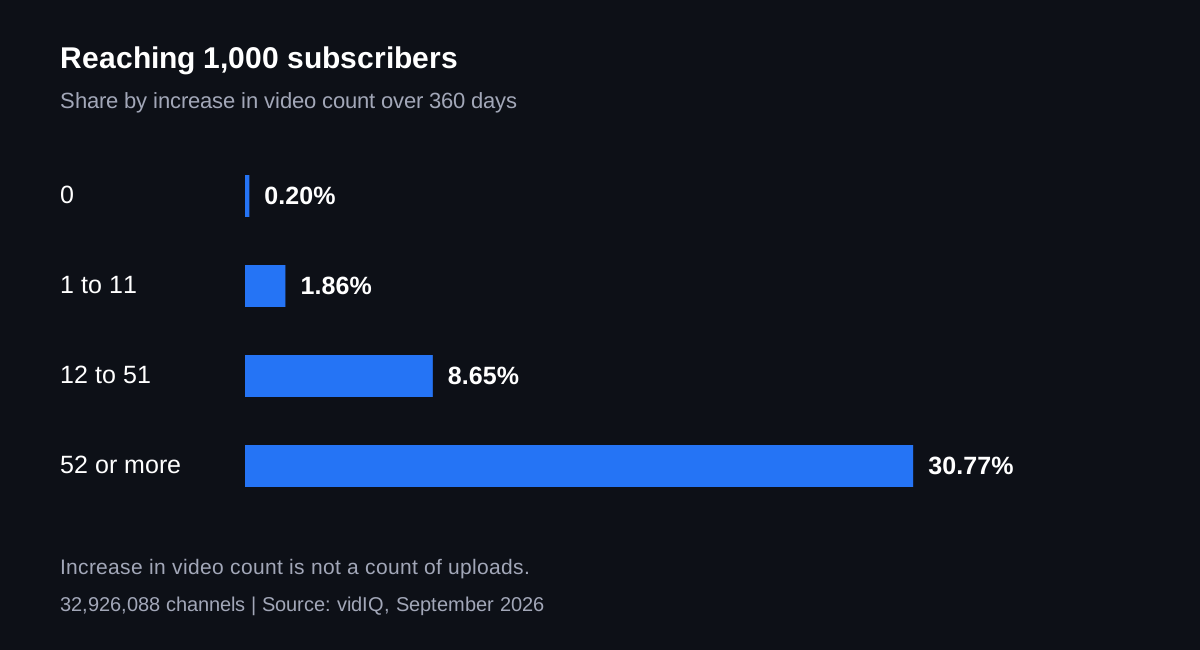
| Increase in video count | Channels | Reached 1,000 | Share |
|---|---|---|---|
| 0 | 27,360,211 | 56,008 | 0.20% |
| 1 to 11 | 3,423,276 | 63,657 | 1.86% |
| 12 to 51 | 1,259,198 | 108,952 | 8.65% |
| 52 or more | 883,403 | 271,792 | 30.77% |
More Videos, More Opportunities to Gain Subscribers
The useful takeaway is the pattern, not a magic upload target. Channels whose video counts grew more were more likely to reach 1,000 subscribers. But this comparison does not tell you what would happen if the same channel simply uploaded more. Experience, starting subscriber count, resources, topic choice, and audience fit can all differ between groups.
What this does not prove
- This is an observational association, not proof that uploading caused subscriber growth. The groups were not matched on starting subscriber count, channel age, resources, or content quality.
- No increase in video count does not prove a channel published nothing. Uploads can be offset by removals or changes in video visibility.
- An increase in video count of 52 or more does not demonstrate a weekly schedule. The measure contains no information about how evenly videos were published.
- Reaching 1,000 subscribers does not establish eligibility for monetization or admission to the YouTube Partner Program.
Methodology
- Sample: 32,926,088 distinct channels in vidIQ's tracked channel index, using the September 10, 2026 snapshot. This is not a random sample or a census of all YouTube channels.
- Observation window: current subscriber and video counts were compared with their snapshots 360 days earlier, rather than a 365-day calendar year.
- Eligibility: channels had fewer than 1,000 subscribers and at least one video at the earlier snapshot, with subscriber and video counts available at both endpoints.
- Video measure: current video count minus the count 360 days earlier. Only channels with a zero or positive difference were included; channels with a negative difference were excluded.
- Groups: increases in video count of zero, 1 to 11, 12 to 51, and 52 or more over the observation window.
- Outcome: at least 1,000 subscribers at the endpoint after being below 1,000 at the earlier snapshot. This does not identify the first crossing date or channels that crossed and subsequently fell below 1,000.
- Calculation: the number reaching the endpoint threshold divided by all eligible channels in that group, multiplied by 100. Each channel counts once. Percentages are rounded to two decimal places.
- Format and geography: no format or geographic filter was applied. Channel-level video totals do not separate Shorts, long-form videos, or livestreams, so these are not format-specific findings.
- Coverage limitations: missing-history channels and negative video-count changes are excluded. The comparison cannot identify individual upload, deletion, or privacy-change events. These selection rules may affect the observed rates.