vidIQ Research, July 2026
YouTube Subscriber Benchmarks 2026: What 61 Million Channels Reveal
We analyzed 61.2 million YouTube channels with at least one public subscriber, plus 11.8 million active channels, to show where subscriber milestones rank and what typical growth looks like by channel size.
vidIQ Research/Updated July 20, 2026
Study parameters
61,186,246
Channels analyzed
1+
Public subscribers required
July 20, 2026
Snapshot date
The finding
1,000 subscribers puts a channel ahead of 59.4% of the sample.
Among channels with at least one public subscriber, 24.8 million had reached 1,000 subscribers. The ladder gets much steeper after that: 7.9% had reached 10,000, 1.30% had reached 100,000, and 0.13% had reached 1 million.
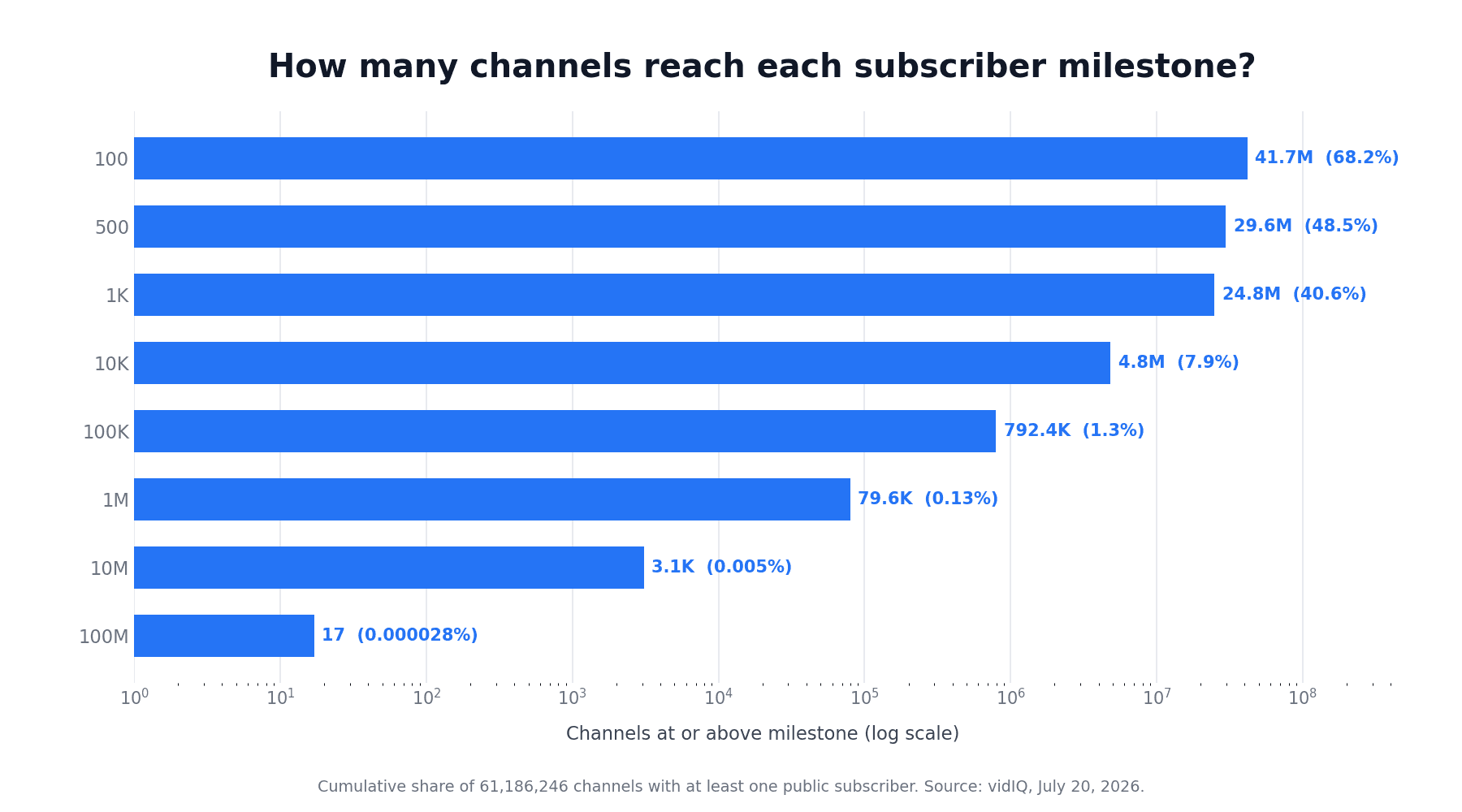
| Subscriber milestone | Channels at or above | Share of sample | Ahead of |
|---|---|---|---|
| 100 | 41,748,268 | 68.2% | 31.8% |
| 500 | 29,649,907 | 48.5% | 51.5% |
| 1,000 | 24,813,187 | 40.6% | 59.4% |
| 10,000 | 4,836,743 | 7.90% | 92.10% |
| 100,000 | 792,376 | 1.30% | 98.70% |
| 1 million | 79,570 | 0.13% | 99.87% |
| 10 million | 3,082 | 0.005% | 99.995% |
| 100 million | 17 | 0.000028% | 99.999972% |
What typical active channel growth looks like
We separately analyzed channels that increased their public video count during the 90 days ending July 20, 2026. Smaller channels grew faster in percentage terms, while larger channels added more subscribers in absolute terms.
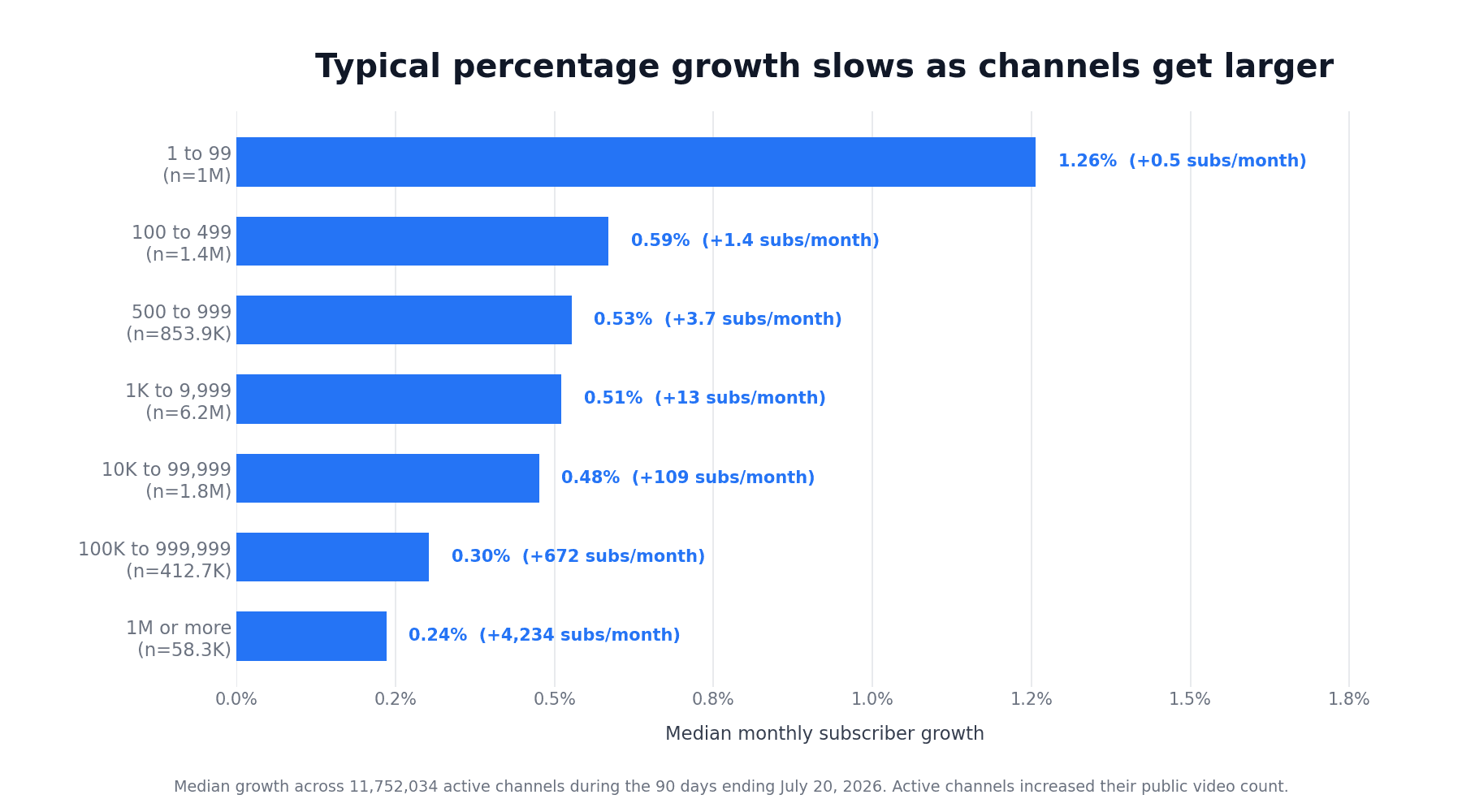
| Starting subscribers | Active channels | Median subs/month | Median %/month |
|---|---|---|---|
| 1 to 99 | 1,047,481 | +0.5 | 1.26% |
| 100 to 499 | 1,430,714 | +1.4 | 0.59% |
| 500 to 999 | 853,903 | +3.7 | 0.53% |
| 1,000 to 9,999 | 6,192,753 | +13 | 0.51% |
| 10,000 to 99,999 | 1,756,249 | +109 | 0.48% |
| 100,000 to 999,999 | 412,660 | +672 | 0.30% |
| 1 million or more | 58,274 | +4,234 | 0.24% |
What this does not prove
This analysis describes channels in vidIQ's public channel index, not every channel ever created on YouTube. The growth results are benchmarks, not targets or proof that channel size causes a specific growth rate. Public subscriber counts are rounded for many channels, so small changes can appear as zero or arrive in steps.
Methodology
- Distribution sample: 61,186,246 unique YouTube channels with at least one public subscriber in a July 20, 2026 warehouse snapshot.
- Quality checks: the source contained 62,578,690 unique channel rows, including 731 with a missing current subscriber count and 1,391,713 with zero subscribers. Those rows were excluded from the distribution sample.
- Milestone definition: each count is cumulative. For example, the 100,000 row includes every channel with 100,000 subscribers or more.
- Percentile definition: ahead-of percentages are the share of analyzed channels below the milestone. The median channel in the sample had 508 subscribers.
- Growth sample: 11,752,034 channels with at least one subscriber at the start of the trailing 90-day window and a net increase in public video count during that window.
- Growth bands: channels were grouped by subscriber count at the start of the window, then compared using median net subscribers per month and median percentage growth per month.
- Why medians: medians reduce the influence of a small number of viral outliers. Channels with subscriber declines remained in the sample.
- Comparison caution: changes in vidIQ index coverage can change the sample size. The 61.2 million 2026 sample should not be interpreted as a decline from the larger September 2025 sample.